

Course Description
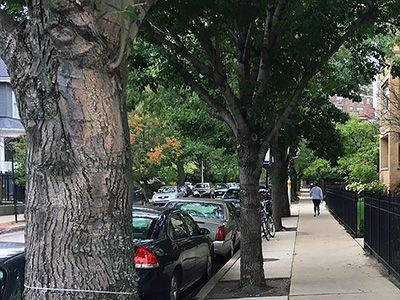
Chicago is one of the country’s great urban forests, with thousands of trees living and breathing around us. These silent residents shape our neighborhoods, impact our health, and remind us of the natural world’s beauty and diversity. In this course, through field trips to neighborhoods, parks, and green oases across the city, you’ll discover peaceful places, learn to identify Chicago’s common tree species, and engage with residents who work for climate action and environmental justice. You’ll investigate how tree canopy varies dramatically across Chicago’s neighborhoods and what this reveals about the city’s historical inequities. Finally, you’ll reflect on and discuss diverse perspectives—from scientific to spiritual—and work with city data to better understand the connections between trees, community well-being, and our shared climate future.
Students who successfully complete the Chicago Quarter will be able to:
- Integrate, in writing, the academic content with student experiences engaging with Chicago;
- Articulate the connection between course content and DePaul University’s mission; and;
- Use Chicago resources in their coursework.
Readings & Media
City of Chicago. (2022, Dec. 13). Tree equity working group year-end report.
Custic, M., & Redlinski, I. (2020). “Common trees of the Chicago region.” Field Museum, Chicago Region Trees Initiative and The Morton Arboretum.
Haskell, D. G. (2018). Callery pears. In The songs of trees: Stories from nature’s great connectors (Reprint edition). Penguin Books.
Kimmerer, R. (2013). Excerpts from Braiding sweetgrass: Indigenous wisdom, scientific knowledge and the teachings of plants (pp. 3–10, 39–47, 105–117, & 141–155). Milkweed Editions.
Konijnendijck, C.C. (2023, Sept. 7). Understanding the social implications and human health effects of urban trees.
Koransky, L. (2022). Excerpts from Drawing trees: Trace thirty different trees and their leaves, branches, and seeds. Princeton Architectural Press.
Pope Francis. (2015). Laudato Sí.
Tekiela, S. (2006). Trees of Illinois field guide (Illustrated edition). Adventure Publications.
Rogers, K. (2023, January 11). “Establishing urban forests should be our legacy.” TEDxVarese.
Roudavski, S. (2020). Respect for old age and dignity in death: The case of urban trees. In Proceedings of the Society of Architectural Historians Australia and New Zealand: 37, What If? What Next? Speculations on History’s Futures (pp. 638–352).
Turner-Skoff, J. (n.d.). The scientific benefits of trees for people. Chicago Region Trees Initiative.
Shared texts (brief poems we’ll engage with together during class)
- Barrax, G. Sr. “I called them trees”
- Gay, R. “To the fig tree on 9th and Christian.”
- Morrison, T. “When great trees fall”
- Olzmann, M. “Letter to the person who carved his initials into the oldest living longleaf pine in North America”
Assignments
Street Trees of Chicago Identification Log & Test: Honeylocust. Green ash. Ginkgo. Catalpa. Hackberry. Norway maple. You’ll demonstrate your knowledge of these and other of Chicago’s common street trees via an ongoing observation log and a short identification test that is completed in the field.
Essay with Images: Why and How We Should Value Urban Trees: In this approximately 5-page essay, you will reflect on the various rationales we have learned about why we should value urban trees (and nature more broadly), explaining 3–4 of these ideas to a general reader and also making suggestions about how to value urban trees. Your essay should substantively engage at least four of our readings/texts and include images generated during your time in the course, which may be photographs or drawings.
Tree Equity Report: For this team project, you and a classmate will research a community area in Chicago, producing a 5-7-page (single-spaced) report that assesses whether this neighborhood should be a priority for tree equity efforts by summarizing data from a site visit to the neighborhood, a conversation with a member of the community, and a range of online demographic, socioeconomic, health, and tree canopy data.
Class Engagement: You will complete regular informal writing tasks, including reading questions to prepare for class and reflections related to field trips. Your class engagement grade combines these tasks and your participation and engagement during class sessions, including Chicago Quarter Practicum.